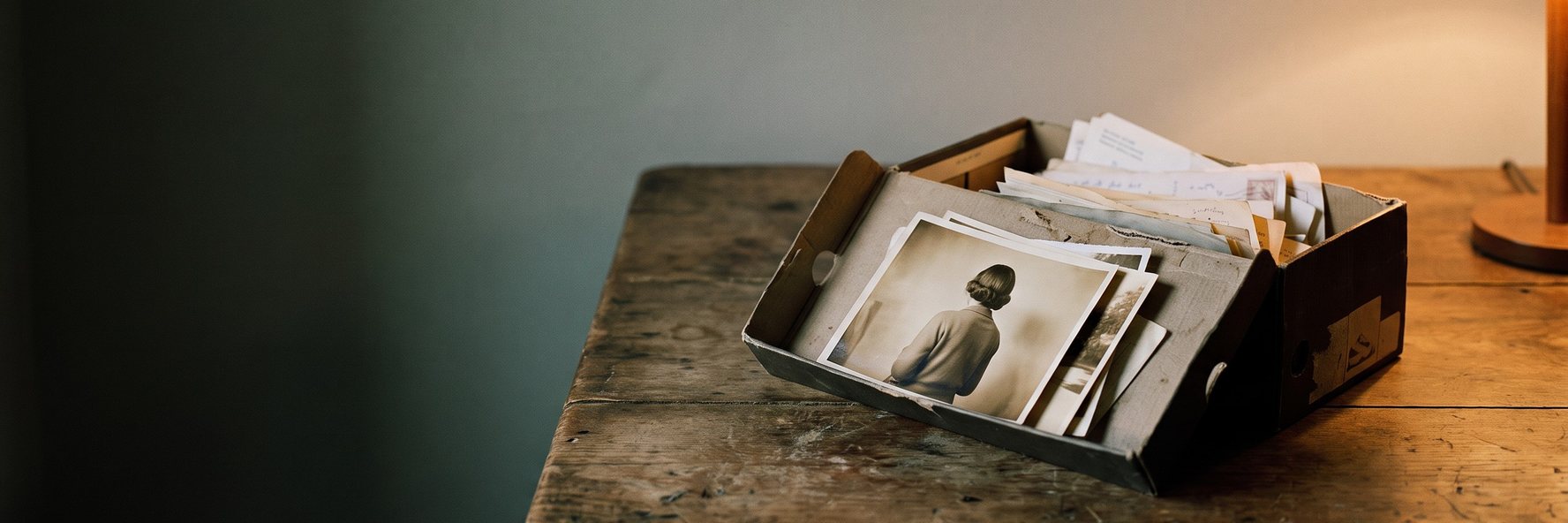

On love, loss and the things left undiscovered.
The death of someone close to us does more than remove their presence from our lives. At times, it also unsettles what we thought we knew about them. A photograph, a letter or a piece of information that comes to light after their death may reveal previously unseen aspects of their inner world: feelings, desires and possibilities that never found expression within the relationship we shared. And so, in a curious way, although the person we have lost is no longer here, our understanding of them continues to unfold.
Even with those closest to us, we never have complete access to their inner world. Each person carries a private reality, shaped by experiences, feelings and aspects of themselves that may never have been shared. We can spend decades alongside someone and still remain unaware of significant parts of who they are.
New knowledge does not simply add another detail to our understanding of a person; it can alter the way we interpret the whole relationship. Memories take on a different significance, while familiar behaviours may be seen in a new light. The past itself remains unchanged, but the meaning we give to it can shift. And as we reconsider the person we have lost, we may also find ourselves looking again at our own lives: our choices, expectations, needs and the things we left unsaid.
Long relationships do not always amount to a shared story experienced in the same way by both people. Two individuals may have lived through the same events, yet understood and felt them quite differently. Love can coexist with disappointment, care with loneliness, tenderness with anger. Recognising this complexity does not mean assigning equal responsibility, nor does it excuse behaviour that caused harm. It simply allows us to acknowledge that more than one truth can exist within the same relationship.
Bereavement gives this process of reconsideration a particular finality. There is no longer an opportunity to ask, clarify, disagree or discover one another differently. Grief, therefore, may involve not only longing for what was, but also sorrow for what never came to be: a deeper closeness, a different kind of understanding, or a side of the other person we never had the chance to know. It is the loss of a possibility that can no longer become part of lived experience.
The search for meaning after loss does not necessarily lead to a final sense of reconciliation with the past. We can hold on to love without idealising the person; acknowledge tenderness without erasing the hurt; and accept that some questions may remain unanswered.
Perhaps, in the end, reading a shared life anew is not about reaching a final verdict. It is about finding a way to hold within the same story what we knew, what we later discovered, and what we may never know.